- 4009 Hackney Springs Ln, Sachse, TX 75048


Need Support?
- 4009 Hackney Springs Ln, Sachse, TX 75048
Need Support?






Running a lab in Wisconsin means juggling two masters: federal CLIA rules and the state’s Division of Quality Assurance. The DQA handles your applications, renewals, and inspections, so you send everything to them, not straight to CMS. That’s where most new lab owners get tripped up.
The fee system changed too. No more paper coupons. Everything runs through Pay.gov now, and if you miss that email with your payment link, your certificate lapses. Then claims stop. Simple as that.
This guide walks you through the entire Wisconsin-specific process, where to submit your CMS-116, how to use the DHS DQA Provider Portal, what changes require a new form versus a quick email, and why your billing company needs to know state rules inside out. We also cover the six most common slip-ups, from expired certificates to test complexity mismatches.
The best approach is to keep your state file, federal certificate, and billing operations in sync. That’s how Wisconsin labs stay compliant and get paid.
If you run a clinical laboratory in Wisconsin, you have to pay attention to multiple things. You are not just responsible for accurate test results and patient safety. You also have to keep your certification current, your fees paid, and your paperwork in perfect order with both federal and state authorities. When any of these pieces slip, insurance claims get denied and revenue stops.
For clinical laboratories, physician office labs, and independent diagnostic testing facilities, the starting point is always the Clinical Laboratory Improvement Amendments (CLIA). This federal program sets the quality standards for all testing on human specimens. In Wisconsin, the state does not issue a separate laboratory license. Instead, the Wisconsin Department of Health Services, through its Division of Quality Assurance, serves as the local partner that handles CLIA applications, renewals, inspections, and record updates.
Understanding how the Division of Quality Assurance works alongside the paperless federal fee system, with dedicated Wisconsin laboratory billing services, keeps your lab legally protected and financially stable.
Any facility that examines human specimens to diagnose, prevent, or treat disease must hold a valid CLIA certificate. The Wisconsin Division of Quality Assurance acts as the state survey agency for the Centers for Medicare and Medicaid Services (CMS). This means the division processes your initial application, reviews your renewal, and conducts on-site surveys based on the complexity of tests your lab performs.
Certificates are issued according to testing complexity. A Certificate of Waiver covers simple tests with a low risk of error. Moderate and high complexity testing requires a Certificate of Compliance or a Certificate of Accreditation. The division’s job is to make sure your facility’s practices match the certificate type you hold. If you bill for a moderate complexity test but only have a waiver certificate, payers like Wisconsin ForwardHealth will flag and reject that claim immediately. The link between your certificate and your billing cannot be ignored.
If you are opening a lab for the first time, the path is easy, but must be followed exactly through these steps:
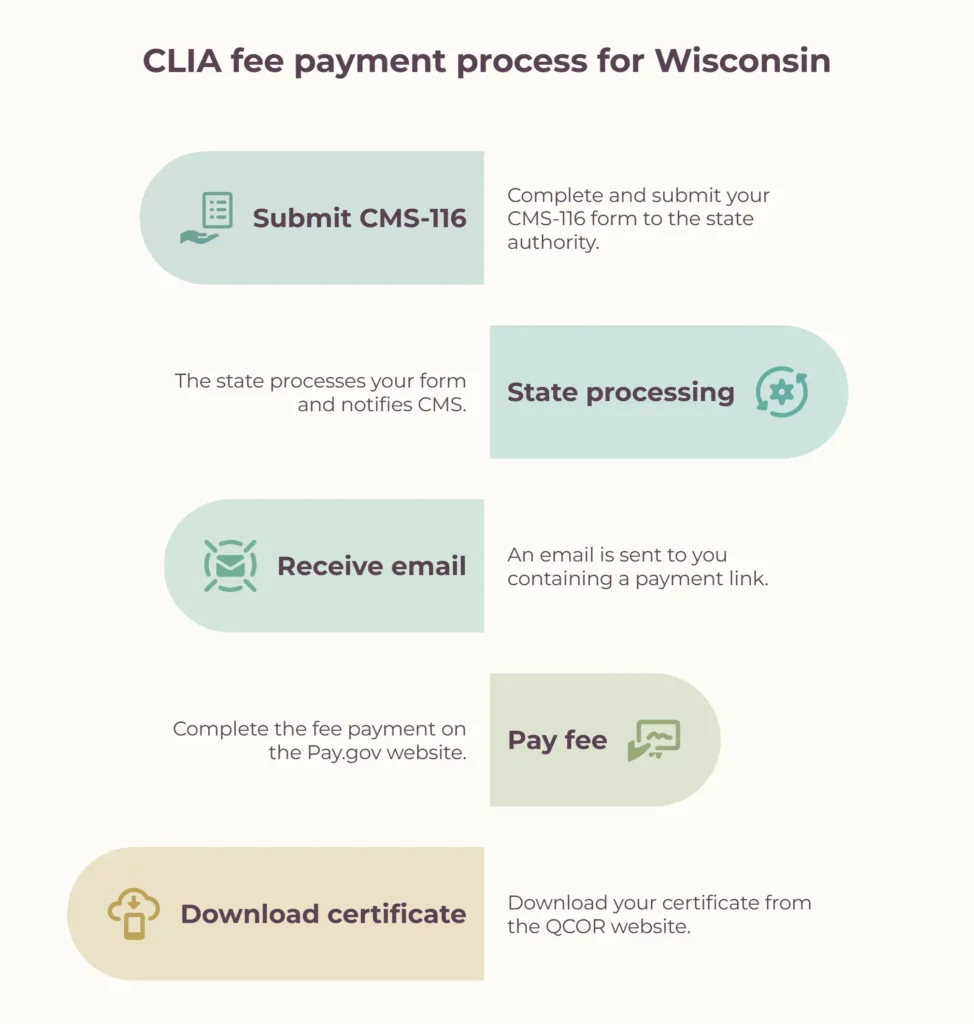
A major change that still confuses billers is the shift to fully paperless CLIA fee payments. In the past, a paper fee coupon would arrive in the mail, and you would mail back a check. That system no longer exists for routine biennial renewals. Now, everything happens electronically, and you have to stay on top of digital notices.
If your laboratory indicated on Form CMS-116 that you prefer to receive notifications by email, you will get a message with a link to your fee coupon when the renewal period opens. If your contact information is outdated or your staff misses that email, the coupon will go unpaid. And when the fee is not paid on time, your certificate can expire, which means your lab is no longer authorized to test human specimens, and every claim you submit during that gap will be denied.
Payment itself is made through the U.S. Department of the Treasury’s Pay.gov platform. You will need your 10‑digit CLIA identification number ready. On the Pay.gov site, you can pay using a credit card, debit card, or electronic check via ACH. After the payment processes, you do not receive a paper certificate in the mail. You must download the official document yourself using the free CMS QCOR Lookup Tool. This is your proof of active certification, and you should save both a digital copy and a printed version for your records and for provider enrollment files.
The simple flow looks like this:
Keeping this chain intact is the foundation of your lab’s compliance.
A laboratory is not a static business. Directors leave, test volumes change, and sometimes you move to a new physical location. Wisconsin requires you to notify the Division of Quality Assurance about many of these events, often within a tight 30‑day window. The state groups these updates into two categories.
Some changes are significant enough that you must file a brand new CMS‑116 form. These include:
For all of these, you have 30 days to submit the fresh form to dhsdqaclia@dhs.wisconsin.gov.
Other changes require only a written notification. Updating your billing address, changing your tax identification number, adjusting your estimated annual test volume, or updating the director for a Certificate of Waiver fall into this group. You can handle these by sending a clear email with the lab’s name, CLIA number, and the effective date of the change to the same state email address. Simple and quick, as long as you do it on time.
Many Wisconsin labs outsource billing to reduce administrative burden and improve claim follow-up. However, outsourcing does not remove the lab’s compliance responsibility. You still need to ensure that the billing partner truly understands Wisconsin’s specific CLIA compliance processes.
Below are the key areas to confirm before finalizing a billing partnership:
A reputed partner, like TransLabs, fulfills the criteria by providing complete Wisconsin billing support. Whether it’s monitoring the DQA portal, managing Pay.gov fee payments, updating payer files through QCOR, and coordinating renewal timelines, a billing partner does that with perfection. This makes sure your CLIA certification stays active, claims stay clean, and revenue stays protected without adding administrative strain to your in-house team.
From a revenue cycle perspective, your CLIA status is far more than paperwork. It is wired directly into the claim submission. Every electronic and paper claim must include the laboratory’s 10‑digit CLIA number in the appropriate field. If the number is missing or entered incorrectly, the claim stops at the clearinghouse and never reaches the payer. That single data element, hard‑coded into your laboratory information system and billing software, must be accurate at all times.
Test complexity also matters. If your billing department adds codes for tests that exceed your certificate’s authorized level, those claims will be seen as non‑compliant. Payers cross‑reference the procedure codes against FDA test complexity assignments. An audit that reveals such mismatches can lead to takebacks and even fraud allegations. Regularly comparing your active CPT codes to your certificate scope is a necessary internal control.
Finally, lapsed certification due to missed fee payments creates a dangerous gap in revenue. Claims with dates of service during a period of inactivity are retroactively denied, and recovering that money is extremely difficult. Many labs use the QCOR Lookup Tool as a monthly checkpoint to verify the expiration date on file so they never miss a renewal.
Good compliance habits protect your lab’s cash flow. These simple steps, done consistently, can prevent the most common problems.
If you plan to add new testing, confirm the certificate upgrade path with the Division of Quality Assurance first.
Wisconsin’s partnership with the federal CLIA program is designed to uphold patient safety without creating unnecessary duplication. When you understand the specific role of the Division of Quality Assurance, the correct submission points, and the entirely digital fee process, staying compliant becomes a manageable routine. A laboratory that keeps its state file, federal certificate, and billing operations aligned is a laboratory that gets paid on time, every time, without interruption.