
- 4009 Hackney Springs Ln, Sachse, TX 75048


Need Support?
- 4009 Hackney Springs Ln, Sachse, TX 75048
Need Support?





Key Takeaways
For years, labs had to guess how tough each payer was on prior authorization. You knew which plans felt painful. You just couldn’t prove it, or compare them on equal terms.
That changed in 2026. Federal rules now make most government-backed health plans publish their prior auth numbers. For a lab juggling dozens of payers and a limited billing team with no reliable lab RCM services, that data is a gift, if you know how to read it.
The requirement comes from CMS-0057-F, the CMS Interoperability and Prior Authorization Final Rule. Impacted payers must post the following metrics on their public websites once a year:
| Metric | What it tells a lab |
|---|---|
| List of all items and services that require prior authorization | Which of your tests are exposed with each payer |
| % of standard requests approved | Baseline friction for routine requests |
| % of standard requests denied | How often requests fail on the first pass |
| % of standard requests approved after appeal | How often a denial turns out to be wrong |
| % of requests with an extended review that were approved | How often payers stall before saying yes |
| % of expedited requests approved and denied | How the payer handles urgent cases |
| Average and median time to decision (standard and expedited) | Cash flow drag and turnaround risk |
| Payer type | Reporting level |
|---|---|
| Medicare Advantage organizations | Organization level |
| State Medicaid and CHIP fee-for-service programs | State level |
| Medicaid managed care plans and CHIP managed care entities | Plan level |
| QHP issuers on the Federally-facilitated Exchanges | Issuer level |
Original Medicare and most employer-sponsored plans aren’t covered. So the public data won’t help you rank every commercial payer, but it does cover a big share of the lab prior auth that hurts most.
There’s also outside research worth reading. KFF’s analyses of Medicare Advantage prior authorization have found that only a small share of denials get appealed, yet most appealed denials are overturned. That gap is the opportunity this article is about.
| Limitation | How to work around it |
|---|---|
| Metrics are aggregated across all services, not lab-specific | Use them to compare payers, then confirm with your own lab claims |
| Large MA organizations report at the organization level | Map your lab’s plans to the right parent organization |
| Data lags by a year | Pair it with your last 90 days of remits |
| Lab benefit managers aren’t broken out | Ask each plan who runs lab prior auth and track that vendor separately |
| Formats differ by payer | Build one standard intake sheet and normalize everything into it |
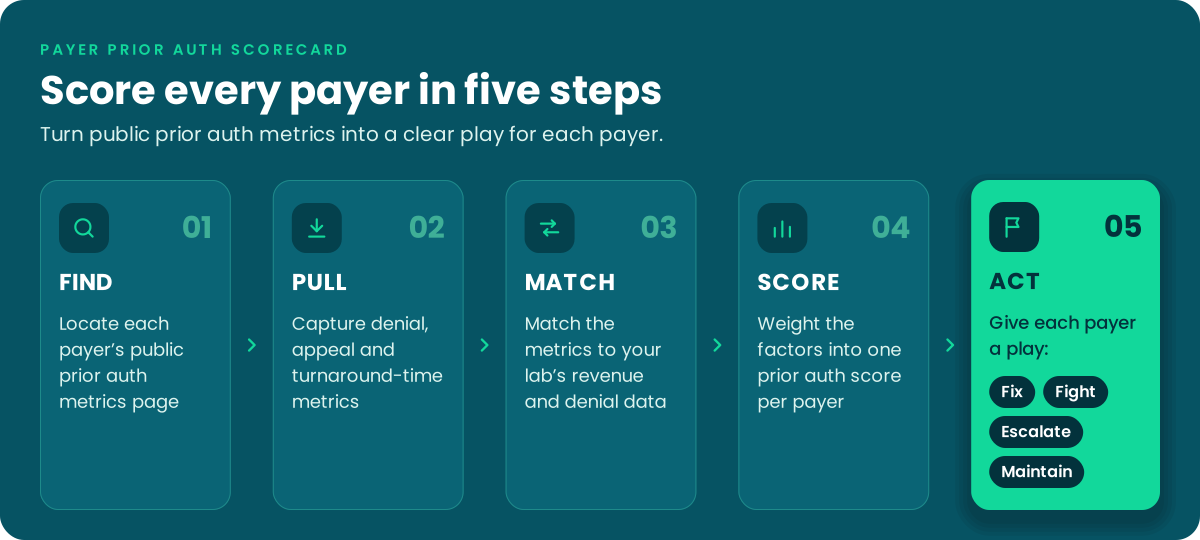
| Factor | Weight | Scoring logic (5 = highest priority) |
|---|---|---|
| Lab revenue at stake | 35% | Higher revenue scores higher |
| Public denial rate | 20% | Higher denial rate scores higher |
| Approved after appeal | 15% | Higher overturns mean more winnable dollars |
| Median decision time | 10% | Slower decisions mean more cash drag |
| Your lab’s prior auth denial rate | 20% | Higher internal denials score higher |
| Payer | Revenue (score) | Public denial (score) | Approved after appeal (score) | Median days (score) | Lab PA denial (score) | Priority score |
|---|---|---|---|---|---|---|
| Payer A (MA plan) | $820k (5) | 9.5% (3) | 4.2% (5) | 5 (3) | 12% (4) | 4.20 |
| Payer B (Medicaid MCO) | $410k (3) | 14.0% (5) | 1.1% (1) | 7 (5) | 18% (5) | 3.70 |
| Payer D (Exchange QHP) | $190k (1) | 11.5% (4) | 3.6% (4) | 6 (4) | 9% (3) | 2.75 |
| Payer C (MA plan) | $560k (4) | 4.0% (1) | 0.8% (1) | 2 (1) | 3% (1) | 2.05 |
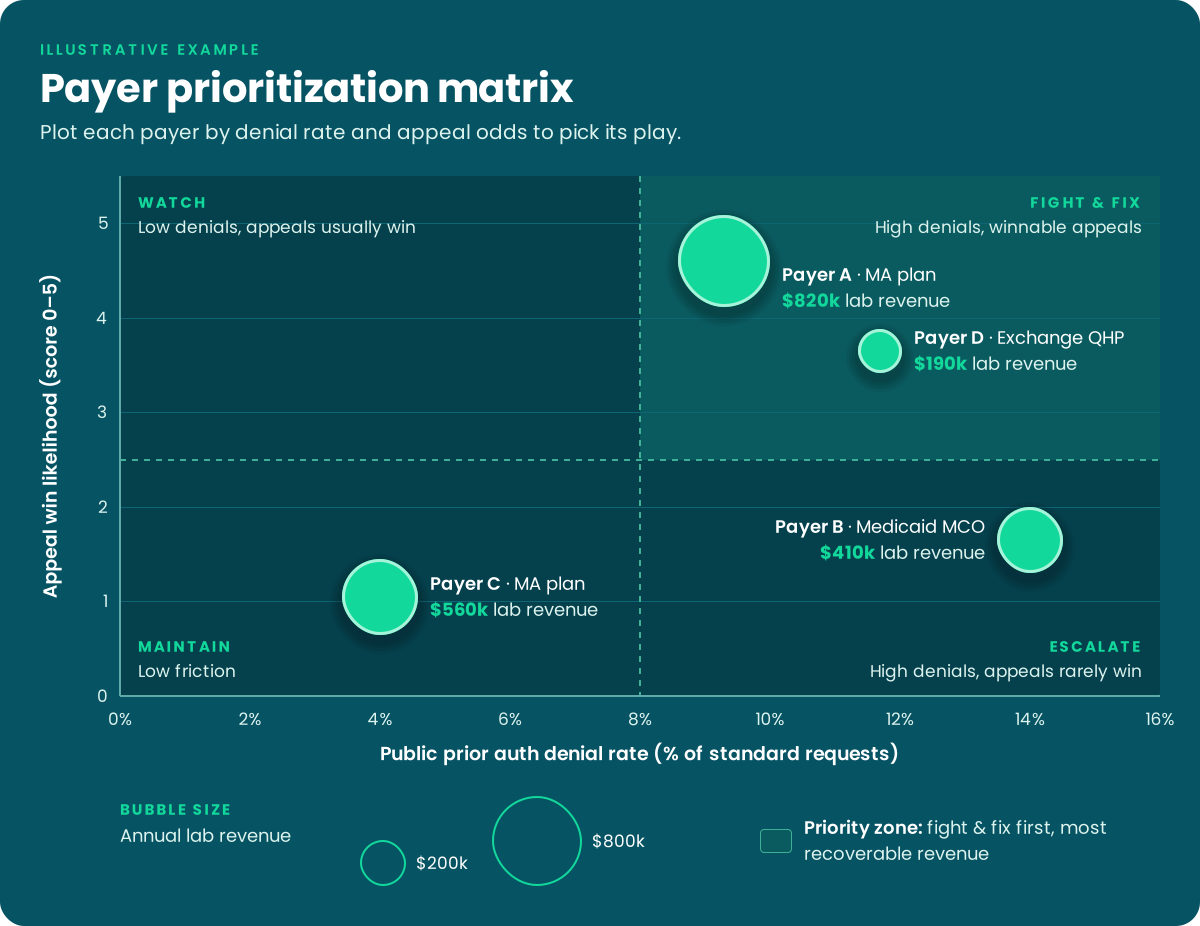
| Quadrant | Signal | Best play |
|---|---|---|
| Fight & fix | High denials, high appeal success | Build appeal templates by test; fix the documentation gaps behind repeat denials |
| Escalate | High denials, low appeal success | Meet with provider relations; challenge policy criteria; review contract terms |
| Watch | Low denials, high appeal success | Spot-check denials; appeal the outliers |
| Maintain | Low denials, low appeals | Keep eligibility and prior auth checks tight; review yearly |