
- 4009 Hackney Springs Ln, Sachse, TX 75048


Need Support?
- 4009 Hackney Springs Ln, Sachse, TX 75048
Need Support?





State AI-denial laws restrict how health insurers and utilization review vendors use artificial intelligence and algorithms to deny, delay, or modify care. California’s SB 1120 (the Physicians Make Decisions Act), effective January 1, 2025, set the template: AI may assist, but medical necessity denials must be made by a licensed physician or qualified health care professional, and AI tools must weigh the individual patient’s history rather than group data alone. Texas, Maryland, Arizona, and other states have since enacted their own versions, and many more have bills pending.
For clinical laboratories, these laws add a second appeal argument on top of medical necessity: whether the denial was made the right way. That opens the door to requesting reviewer credentials, documenting automated denial patterns, and escalating to state regulators. The laws mainly reach fully insured, state-regulated plans. Self-funded ERISA plans and Medicare Advantage follow federal rules, which carry their own individual-review and disclosure requirements.
Key Takeaways
Labs know the feeling. A molecular panel is denied minutes after the claim posts. The letter says “not medically necessary” and nothing else. You appeal, wait, and usually win. But the cash sits idle for months, and the same denial hits the next 200 claims.
Many in the industry have long suspected algorithms drive much of that volume. Investigations and lawsuits brought those suspicions into the open, and state lawmakers acted. This guide explains what state AI-denial laws actually require, which denials they cover, how federal rules fill the gaps, and exactly how labs should rebuild their appeals around them using lab denial management services.
| Term | Definition |
|---|---|
| Utilization review (UR) | A health plan’s process for deciding whether a service is medically necessary and covered, before or after it’s provided |
| Prior authorization | Approval a plan requires before a service, such as a molecular or genetic test, is performed |
| Adverse determination | A denial, reduction, delay, or modification of coverage based on medical necessity |
| Automated decision system | Software, including AI and rules-based algorithms, that scores or decides claims or requests |
| Individualized review | A decision based on the specific patient’s records and clinical circumstances, not group averages |
| Fully insured plan | Coverage where an insurer bears the risk; regulated by the state |
| Self-funded (ERISA) plan | An employer pays claims directly; governed mainly by federal ERISA, not state insurance law |
| External review | An independent review of a plan’s final internal denial, available under the ACA for most plans |
Short answer: They are state laws that limit how health plans use AI and algorithms in utilization review. Most say AI can assist, but a licensed clinician must make any medical necessity denial, and the decision must reflect the individual patient.
The laws vary in wording, but most share four principles:
Short answer: Public investigations and class-action lawsuits alleged that large insurers used algorithms to deny claims in bulk with little or no clinician review. Lawmakers responded by requiring human, individualized decisions.
| Event | What was alleged or reported | Why it matters to labs |
|---|---|---|
| ProPublica investigation of Cigna’s PxDx system (2023) | Reported that Cigna medical directors denied more than 300,000 claims over two months, spending an average of 1.2 seconds on each | PxDx matched diagnosis codes to procedure codes, the same logic that drives many lab test denials |
| Class actions over Medicare Advantage post-acute care algorithms (2023 onward) | Suits against UnitedHealth and Humana alleged an AI tool overrode clinician judgment on coverage | Showed regulators and courts are willing to scrutinize algorithmic denials |
| U.S. Senate Permanent Subcommittee on Investigations report (2024) | Found sharp increases in some large MA insurers’ post-acute prior authorization denial rates | Fueled federal and state pressure on automated utilization review |
Short answer: SB 1120, the Physicians Make Decisions Act, took effect January 1, 2025. It requires California health plans and disability insurers to make medical necessity denials through a licensed physician or qualified health care professional, with AI used only as support.
| SB 1120 requirement | What it means for a lab appeal |
|---|---|
| AI tools must base decisions on the enrollee’s medical history and individual clinical circumstances | A denial that ignores the submitted clinical notes is open to challenge |
| AI can’t supplant the treating provider’s decision-making | The ordering clinician’s rationale carries real weight |
| Medical necessity denials, delays, or modifications must be made by a licensed physician or qualified health care professional | Ask who made the decision and request their credentials |
| Tools must not discriminate and must be applied fairly and equitably | Patterns by test type or patient group can go to regulators |
| Tools, policies, and procedures must be open to regulator inspection | DMHC and CDI complaints have teeth |
| Tools must be periodically reviewed and revised | Sudden shifts in denial patterns are worth documenting |
Short answer: California, Texas, Maryland, and Arizona are among the states that have enacted laws limiting AI-driven utilization review denials. Many more states have bills pending, and the list grows each legislative session.
| State | Law | Core rule | Effective |
|---|---|---|---|
| California | SB 1120 (Physicians Make Decisions Act) | Licensed clinician must make medical necessity denials; AI must use individual patient data | January 1, 2025 |
| Texas | SB 815 | Bars utilization review agents from using automated decision systems to make adverse determinations | September 1, 2025 |
| Maryland | HB 820 | Sets standards for carriers’ use of AI in utilization review, including individualized review and oversight | October 1, 2025 |
| Arizona | HB 2175 | Requires a medical director to individually review medical necessity denials rather than rely on AI alone | July 1, 2026 |
| Approach | How it works | Strength for lab appeals |
|---|---|---|
| Clinician-decides laws | A licensed clinician must make medical necessity denials (e.g., California, Arizona) | Strong: a denial without clinician review is a direct violation |
| Automation limits | Automated systems can’t be used to make adverse determinations (e.g., Texas) | Strong: shifts focus to how the decision was made |
| Governance and disclosure | Insurers must document, test, and oversee AI tools (e.g., NAIC bulletin states, Maryland standards) | Moderate: best used in regulator complaints and pattern cases |
Short answer: No. They generally apply to fully insured, state-regulated plans. Self-funded employer plans fall under federal ERISA, and Medicare Advantage follows federal CMS rules that usually preempt state coverage standards.
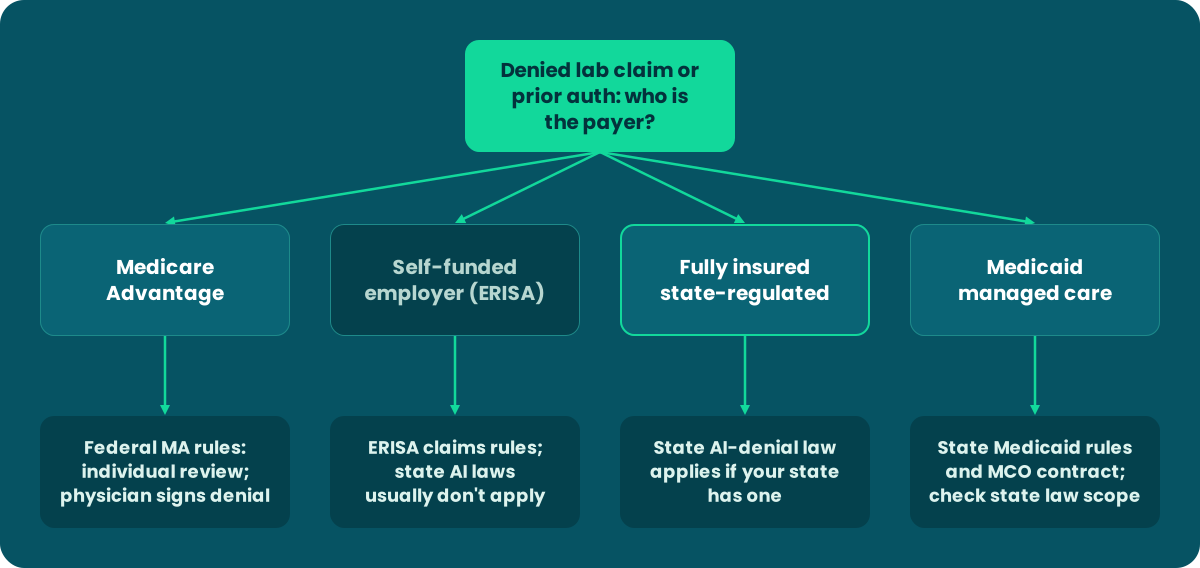
| Plan type | State AI law applies? | Main rules to cite instead or as well |
|---|---|---|
| Fully insured commercial (state-regulated) | Yes, if the state has a law | State AI law, state UR statute, ACA appeal and external review rights |
| Self-funded employer (ERISA) | Usually no | ERISA claims procedure rules, ACA external review |
| Medicare Advantage | Generally no (federal preemption) | CMS MA regulations and guidance, MA appeal levels |
| Medicaid managed care | Depends on state law and MCO contract | State Medicaid rules, MCO contract terms, state fair hearing |
| Original Medicare | No | MAC appeal process, LCD/NCD criteria |
A quick tip: the plan type often isn’t obvious from the ID card. Check the eligibility response, the plan documents, or ask the payer directly whether the plan is fully insured or self-funded before you choose your legal argument.
Short answer: Medicare Advantage plans must base coverage decisions on the individual patient, not an algorithm alone, and medical necessity denials must be reviewed by a physician or appropriate health professional. ERISA plans must disclose the medical experts consulted on appeal.
| Federal source | What it requires | How labs use it |
|---|---|---|
| CMS Medicare Advantage rules and February 2024 CMS guidance | Plans may use algorithms or AI to assist, but coverage decisions must reflect the individual patient’s circumstances; denials based on medical necessity must be reviewed by a physician or other appropriate health care professional | Cite when an MA denial shows no sign of individual review |
| ERISA claims procedure regulation | On appeal, claimants can get relevant documents and the identity of medical experts whose advice was obtained | Request reviewer identity and the criteria used |
| ACA internal appeal and external review rules | Most plans must offer internal appeals and independent external review of final denials | Escalate repeat medical necessity denials outside the plan |
| CMS-0057-F (Interoperability and Prior Authorization Final Rule) | Impacted payers must give a specific reason for prior auth denials | Use the stated reason to target your rebuttal |
Short answer: Look for speed, sameness, and silence: denials issued seconds after submission, identical wording across many claims, and no reference to the patient’s clinical records.
| Signal | What it looks like on lab claims |
|---|---|
| Speed | Denials returned within minutes or seconds of submission, including after hours |
| Sameness | Identical denial text across dozens of claims for the same CPT or PLA code |
| Code-matching logic | Denials tied only to a missing or mismatched ICD-10 code, even when records support the test |
| Silence on records | No mention of attached clinical notes or the ordering provider’s rationale |
| Volume spikes | A sudden jump in denials for one test after a payer policy or vendor change |
| Generic reviewer | Letter signed by a title or department rather than a named, credentialed clinician |
Short answer: Identify the plan type, document automation signals, request reviewer credentials and criteria, attach full clinical records, cite the specific law, and escalate to external review or the state regulator if the plan doesn’t correct the denial.
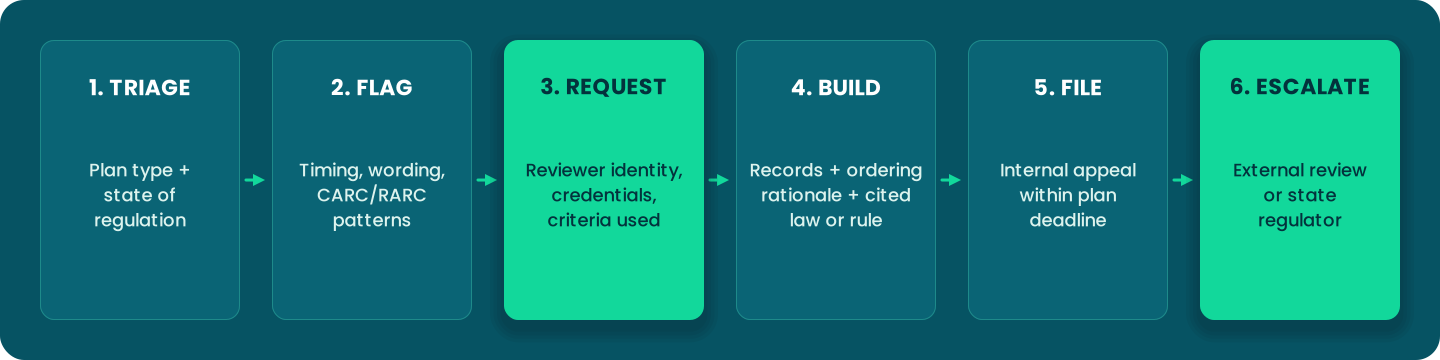
| Step | What to do | Why it matters |
|---|---|---|
| 1. Triage | Confirm plan type and state of regulation | Decides which law or rule you can cite |
| 2. Flag | Log denial timing, wording, and CARC/RARC codes | Builds pattern evidence |
| 3. Request | Ask for reviewer identity, credentials, and criteria used | Tests whether a clinician made the call |
| 4. Build | Attach records, the ordering provider’s rationale, and payer policy citations | Shows individual facts were available |
| 5. File | Submit the internal appeal within the plan’s deadline | Preserves appeal and external review rights |
| 6. Escalate | Request external review or file a regulator complaint | Adds outside pressure on repeat problems |
Adapt to your case and have counsel review before use
“We request reconsideration of the denial dated [date] for CPT [code] for patient [ID]. The denial was issued [timeframe] after submission, uses language identical to [number] other denials for the same code, and does not reference the clinical documentation provided.
Under [state law, e.g., California Health and Safety Code provisions enacted by SB 1120 / applicable federal rule], medical necessity determinations must be made by a licensed physician or qualified health care professional based on the enrollee’s individual clinical circumstances. Please provide the name, specialty, and license of the reviewer, the clinical criteria applied, and all documents relied upon.
The enclosed records and ordering provider’s statement establish that this test was reasonable and necessary for the patient’s diagnosis of [condition, ICD-10].”
| Test category | Why automated review targets it | Appeal focus |
|---|---|---|
| Molecular and genetic testing | High cost, frequent prior auth, policy-driven criteria | Clinical history, family history, guideline citations |
| Pharmacogenomic panels | Narrow coverage policies and frequency limits | Medication list and prescribing decision tied to results |
| Toxicology and drug testing | High volume; frequency and panel-size edits | Treatment plan and testing frequency rationale |
| Infectious disease panels | Panel size and diagnosis-code matching | Symptoms, risk factors, why a panel beat single tests |
| Routine high-volume tests | Diagnosis-to-code matching at scale | Correct ICD-10 linkage and chart support |
| KPI | How to calculate | Why it matters |
|---|---|---|
| Median time to denial | Hours from submission to denial, by payer | Very short times can point to automation |
| Duplicate-language rate | Share of denials with identical text, by test | Shows template or algorithmic decisions |
| Appeal overturn rate | Overturned appeals ÷ appeals filed | High overturns show weak initial decisions |
| Reviewer disclosure rate | Requests answered with a named, credentialed reviewer ÷ requests made | Tests compliance with clinician-review rules |
| Days in AR for denied claims | Average days from denial to payment | Measures the cash cost of bad denials |