
- 4009 Hackney Springs Ln, Sachse, TX 75048


Need Support?
- 4009 Hackney Springs Ln, Sachse, TX 75048
Need Support?





Key Takeaways
Ask anyone who runs the front end of a molecular lab what their week consists of, and you’ll hear some version of the same thing. The specimen came in. The order looks clean. Nobody started the prior authorization. Now someone at the lab is on hold with a benefit manager, faxing chart notes the ordering office still hasn’t sent.
CMS-0057-F was written to shrink that mess. It won’t erase it, and it won’t reach every payer on your remit. But for Medicare Advantage, Medicaid, CHIP, and federal Exchange plans, the deadline of January 1, 2027 changes how prior auth gets requested, documented, and decided. Whether you use outsourced lab RCM services, or manage pre-auths yourself, it’s important to delve into what the rule actually says, and where labs need to pay attention.
CMS-0057-F is the CMS Interoperability and Prior Authorization Final Rule. CMS released it on January 17, 2024, and it was published in the Federal Register on February 8, 2024. It builds on the 2020 interoperability rule (CMS-9115-F), which created the Patient Access API.
The rule does two things. First, it sets operational rules for prior authorization: decision deadlines, denial reasons, and public reporting. Second, it requires payers to build standardized APIs on HL7 FHIR R4 so that prior auth data moves between systems instead of between fax machines. CMS estimated the rule would save roughly $15 billion over ten years, mostly in physician and staff time.
| Payer type | Covered by CMS-0057-F? | What it means for labs |
|---|---|---|
| Medicare Advantage organizations | Yes | Biggest impact for labs serving older patients; MA plans heavily manage genetic and molecular testing |
| Medicaid fee-for-service (state programs) | Yes | States may request a one-time extension of up to one year on API deadlines |
| Medicaid managed care plans | Yes | Deadlines tied to rating periods starting on or after Jan 1, 2027 |
| CHIP fee-for-service and managed care | Yes | Same requirements as Medicaid |
| QHP issuers on Federally-facilitated Exchanges | Yes, partly | API and denial-reason rules apply; the 72-hour/7-day timeframes do not |
| Employer-sponsored and ERISA commercial plans | No | No federal API mandate; state laws and the voluntary June 2025 AHIP pledge may still apply |
| Traditional Medicare fee-for-service | No | Not an impacted payer; MolDX test registration and coverage rules are a separate process |
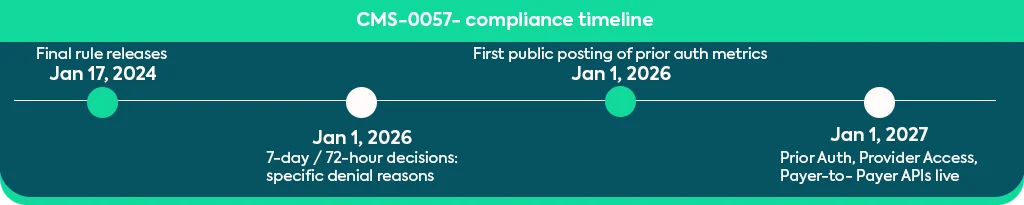
| Date | Requirement | Applies to |
|---|---|---|
| Jan 1, 2026 | Standard prior auth decisions within 7 calendar days; expedited within 72 hours | MA, Medicaid, CHIP (not QHPs) |
| Jan 1, 2026 | Specific reason for every denial, regardless of submission method | All impacted payers |
| Mar 31, 2026 | First annual public posting of prior auth metrics (2025 data); first Patient Access API usage metrics reported to CMS | All impacted payers |
| Jan 1, 2027 | Prior Authorization API live | All impacted payers |
| Jan 1, 2027 | Provider Access API, Payer-to-Payer API, and prior auth data added to Patient Access API | All impacted payers |
| CY 2027 | New yes/no attestation measure, Electronic Prior Authorization, in MIPS Promoting Interoperability and the Medicare PI Program | Clinicians, hospitals, CAHs |
| API | What it does | Why a lab cares |
|---|---|---|
| Prior Authorization API | Tells providers whether an item or service needs prior auth, lists required documentation, accepts the request, and returns an approval (with its end date), a denial (with a specific reason), or a request for more information | The core change. Fewer guesses about which CPT codes need auth |
| Provider Access API | Lets in-network providers with a treatment relationship pull a patient's claims, encounter, and prior auth data | Ordering clinicians can see prior testing, which may reduce duplicate orders |
| Payer-to-Payer API | Moves up to five years of data, including prior auth decisions, when a patient switches plans (patient opt-in) | Helps continuity when a patient on a serial monitoring test changes plans |
| Patient Access API (expanded) | Adds pending and active prior auth decisions for patients to view in apps | Patients can see auth status, which changes the questions your call center gets |
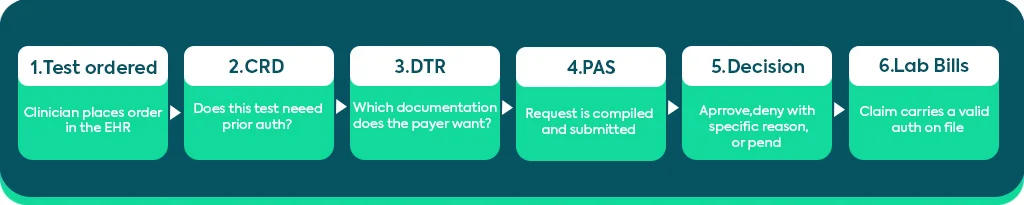
| Da Vinci guide | Full name | The question it answers |
|---|---|---|
| CRD | Coverage Requirements Discovery | Does this test need prior auth for this patient and plan? |
| DTR | Documentation Templates and Rules | Which clinical documentation does the payer want, and can the EHR fill it in? |
| PAS | Prior Authorization Support | How does the completed request reach the payer and the decision come back? |
Here’s the part most explainers skip. The API is designed to fire inside the ordering clinician’s EHR at the moment of the order. CRD runs when the physician picks the test. DTR pulls documentation from the chart. That works nicely for a cardiology office ordering an echo.
Labs live downstream. The test is ordered in one system and performed in another. Your LIS rarely holds the progress notes, family history, or prior results a payer wants for a hereditary cancer panel. So the rule helps labs most when the ordering office actually uses it, and much less when an order shows up by requisition with the auth field blank.
In April 2026, CMS released a proposed rule, CMS-0062-P, that builds on CMS-0057-F. It would carry many of the same prior auth requirements over to drugs and add small-group insurers on the ACA small business exchange. It would also adopt HL7 FHIR standards for prior authorization under HIPAA, which would reach every covered entity that exchanges prior auth electronically. That includes providers and clearinghouses, not just payers.
Comments closed June 15, 2026, and the rule isn’t final. Still, the direction is clear. FHIR-based prior auth is heading toward a HIPAA standard, and labs that plan for it now won’t be scrambling later.
| Area | Action before January 2027 | Owner |
|---|---|---|
| Payer mix | Separate MA, Medicaid, CHIP, and QHP volume from commercial so you know your covered share | RCM lead |
| Code-level rules | Map which CPT/HCPCS codes each covered payer and benefit manager requires auth for today | Prior auth team |
| Ordering clients | Ask top referring practices whether their EHR vendor supports CRD, DTR, and PAS | Client services |
| LIS and billing system | Ask your vendors how they will receive auth numbers and status from FHIR workflows | IT / vendor manager |
| Denial tracking | Tag denials by CARC 197, 198, and 15 so auth failures are measurable | Denial management |
| Timeframe audits | Log submission and decision dates against the 72-hour and 7-day limits | Prior auth team |
| Appeals templates | Rebuild appeal letters to answer the payer's stated denial reason point by point | Appeals team |
| Metric | How to calculate | Why it matters |
|---|---|---|
| Auth turnaround | Median days from submission to decision, by payer | Tests the 7-day and 72-hour limits |
| Auth-related denial rate | Claims denied with CARC 197, 198, or 15 ÷ total claims, by payer | Shows where the front end leaks revenue |
| Retro-auth rate | Tests performed before auth was requested ÷ tests needing auth | Flags ordering clients who need education |
| Overturn rate on appeal | Auth denials overturned ÷ auth denials appealed | Measures whether specific denial reasons help you win |
| Electronic submission share | Auths sent via API or portal ÷ total auths | Tracks the shift away from fax and phone |
The rule moves the starting line. It doesn’t run the race for you. Labs will still need a partner to chase missing documentation, work the commercial plans that sit outside the mandate, and appeal denials with the specificity payers now owe you.
That’s the work TransLabs does every day for reference, molecular, toxicology, pathology, and hospital outreach labs. If you’d like to see where prior auth is costing your lab today, and how much of it CMS-0057-F will actually touch, we’re happy to walk through your numbers with you.