
- 4009 Hackney Springs Ln, Sachse, TX 75048


Need Support?
- 4009 Hackney Springs Ln, Sachse, TX 75048
Need Support?





Your Lab May Be Losing Money Right Now!
Find out fast with a
No-Cost Revenue Audit.

Payers don’t pay labs just because a claim shows up. They check the CLIA number first against the certificate, the test complexity, the expiration date. If anything’s off, payment stops. Could be a digit transposed in Box 23. Could be a test that falls outside what the certificate actually covers. Either way, the claim comes back, and someone has to dig through the mess.
This guide lays out how certificate types line up with test complexity, what the QW modifier actually does for waived tests, and where billers mess up most often missing numbers, expired certs, multi-site mix-ups, registration period billing, and complexity coding errors.
The real fix? Keep CLIA status, test menus, locations, and payer enrollment in sync. When billing and lab operations talk to each other, denials drop. Revenue stays steady. That’s not compliance for compliance’s sake—that’s protecting what you’ve earned.
Most laboratory claim denials don’t arrive all at once. They build quietly, starting with a claim that didn’t pay on time here, a reimbursement that came back short there. By the time the pattern is obvious, the cash flow gap is already real, and someone is already asking why.
For the most part, coding errors or incomplete documentation take the blame. But a lot of those denials trace back to a CLIA compliance gap – an expired certificate, a mismatched number, or a test billed at the wrong complexity level for what the lab is actually certified to perform.
The result?
More denied claims. More time spent fixing avoidable errors. More strain on cash flow consistency.
For many billing teams, CLIA remains a laboratory operations responsibility, something handled long before a claim reaches submission. That assumption can be costly. A missing, expired, or mismatched CLIA number can stop reimbursement before payment is ever released.
For billing professionals, understanding how CLIA affects claims is not just a compliance concern. It is a revenue protection strategy. This blog breaks down where CLIA intersects with reimbursement and how to submit clean claims with laboratory billing services to prevent avoidable revenue loss.
Clinical Laboratory Improvement Amendments (CLIA), enacted in 1988, establish federal standards for laboratory testing performed on human specimens. CLIA in billing refers to the certification requirements that laboratories must meet before they bill and receive payment for diagnostic testing services.
Put simply, payers such as Medicare, Medicaid, and most commercial plans won’t reimburse lab services unless the performing facility holds the appropriate CLIA certification for those tests. The CLIA number on a claim is used to verify it.
An active CLIA number on the claim tells the payer that the lab is certified, it covers the test being billed, and the results are coming from a facility according to federal quality standards. When that number is missing, wrong, or tied to the wrong certificate level, payment stops.
CLIA isn’t just a quality assurance program. For billing purposes, it functions as a reimbursement gate, one that billing teams need to understand well enough to keep claims moving through it cleanly.
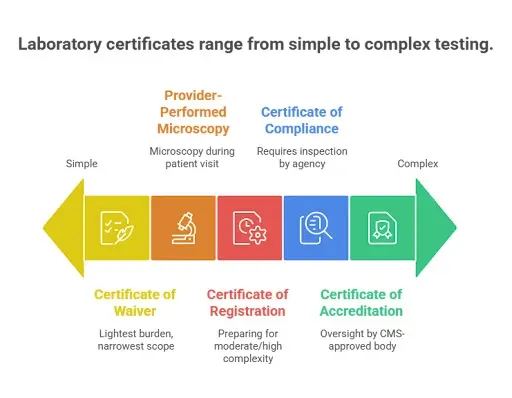
Not all laboratories operate under the same level of certification. Since laboratory tests vary in complexity, the Centers for Medicare & Medicaid Services (CMS) issues different CLIA certificates based on the type of testing a facility performs.
The certificate a lab holds determines exactly what it can perform and bill. Billing outside that scope, even unintentionally, creates claim exposure that ranges from straight denials to post-payment audit risk.
Here are the five types of CLIA certification:
Let’s explore all these types.
Certificate for Provider-Performed Microscopy Procedures, commonly abbreviated as PPMP, is designed for qualified providers who personally perform certain microscopic examinations with moderate complexity during a patient visit.
Examples include wet mounts and potassium hydroxide (KOH) preparations. Facilities with this certificate may also perform waived tests.
This is a temporary certificate issued to laboratories preparing to perform moderate or high-complexity testing.
The Certificate of Registration keeps operations moving while full certification is pending, but billing under it isn’t straightforward. Payer requirements vary, and finding that out after a denial is the harder way to learn it.
Functionally similar to the Certificate of Compliance in terms of what it authorizes: moderate and high-complexity testing. But the oversight comes from a CMS-approved accreditation body like the College of American Pathologists rather than direct CMS inspection. Most hospital-based labs and larger reference labs fall here.
Each certificate type draws a firm line around what a lab can legally bill. If the service on the claim doesn’t align with the certificate on file, that claim is going to have a problem, and usually not an obvious one until it’s already in the denial queue.
While we’ve discussed the types of CLIA certificates, the real effort lies in obtaining one. Whether you receive laboratory credentialing services from experts or manage the process yourself, you must make sure to fulfill all the requirements. Here are the steps required to get a CLIA certification:
Clinical Laboratory Improvement Amendments classify tests into three different categories: waived, moderate, and high. These complexity categories aren’t just clinical designations, but are billing boundaries.
A lab can only bill for tests within its complexity authorization. This is where the certificate type becomes directly relevant to every claim that goes out.
| Complexity Level | Examples | Certificate Required | Billing Risk if Miscoded |
|---|---|---|---|
| Waived | Blood glucose, rapid strep, urine dipstick | Certificate of Waiver (minimum) | QW modifier missing → denial |
| Moderate | CBC, chemistry panels, immunoassays | Certificate of Compliance or Accreditation | Wrong certificate → scope violation |
| High | Cytology, flow cytometry, LCMS, molecular diagnostics | Certificate of Compliance or Accreditation | Miscoding + scope violation → audit exposure |
The CLIA application, Form CMS-116, captures your lab’s legal name, physical address, ownership structure, and testing complexity. It’s very important to keep all the details accurate. A simple mismatch in the address or business name can delay certification by weeks. Most states process the application through their state CLIA program, though some labs in non-deemed states file directly with CMS. Supporting documents like your state clinical laboratory license and ownership records often accompany the form depending on your state’s requirements.
Before submitting, verify that your lab’s legal name and physical address match the details on file with your state licensing board and any payer enrollment records. Inconsistent information is a common reason applications get returned for correction. Keep a copy of the submitted application and any correspondence from the state or CMS, since these records are useful during future renewals, inspections, and payer audits.
CLIA fees depend on your certificate type and testing complexity. Waived labs pay a lower fee, while moderate and high complexity labs pay higher amounts due to the survey requirements. The fee is paid after the application is accepted, and underpayment or misdirected payment is a common cause of processing delays. Some states also charge separate state-level fees on top of the federal CLIA amount, which creates confusion for labs managing CLIA compliance without a dedicated credentialing team.
Confirm the current fee schedule with your state CLIA office or CMS before submitting payment. Payment methods vary by state. Some accept electronic transfers, while others require checks sent by mail. Keep a record of the payment confirmation, including the date, amount, and reference number. This documentation is essential if a discrepancy arises and helps prove that your lab was in active compliance during the application process.
Moderate and high complexity labs must pass an initial survey before certification is granted. The surveyor reviews your quality control procedures, personnel qualifications, and testing processes against CLIA standards. Preparation is key. Labs that find it difficult to arrange for documentation before the survey often get cited for avoidable deficiencies. Common findings include missing competency assessments, incomplete instrument maintenance logs, and undocumented corrective actions.
During the survey, the inspector may review a sample of test results, interview staff about standard operating procedures, and evaluate your lab’s adherence to quality control requirements. After the visit, you receive a report outlining any deficiencies. You’ll be expected to respond with a correction plan and proof of corrective action. Responding promptly and thoroughly can reduce the risk of repeat surveys and keep your certification timeline on schedule.
Once your lab passes the survey or completes the waived application process, the CLIA certificate is issued. The certificate lists your lab’s name, address, and testing complexity, and it must be posted visibly in the lab. More importantly, the certificate details must match your payer enrollment records exactly. Any mismatch, such as an old address, an outdated lab name, or a complexity level that no longer reflects your operations, will cause payer validation failures and denied claims.
Review the certificate immediately upon receipt. Compare every field against your claims system, clearinghouse setup, and payer enrollment records. If you find a discrepancy, contact the CLIA program that issued the certificate and request a correction. Many labs fail to do this check, and the mismatch only surfaces when claims begin getting denied days or weeks later.
CLIA certification is not permanent. Labs must renew every two years, and the renewal process includes confirming that your testing complexity and laboratory information are still accurate. Missed renewals are very common, especially when the primary CLIA compliance contact leaves, or the renewal notice goes to an outdated mailing address. A lapsed certificate means all federal testing claims stop, and payers may suspend reimbursement across the board.
Set renewal reminders at least 90 days before the expiration date. The renewal application mostly requires you to verify that your lab’s operations, test menu, and complexity level remain unchanged. If your lab has added new instrumentation, modified test methods, or changed its physical location, report those changes during renewal. Failing to update this information can complicate the renewal and lead to certification delays.
CMS links laboratory billing directly to CLIA certification status. This means a laboratory can only bill for services that fall within its approved CLIA certificate. If it performs tests outside that scope and submits claims anyway, it is not just a billing error. It can be considered a serious compliance violation under the False Claims Act.
On the CMS-1500 claim form, the CLIA number is reported in Box 23. This number is used by payers to confirm that the laboratory is properly certified, the certificate is active, and tests being billed match the approved level of testing.
Payers also verify this information against the official CLIA database maintained by CMS.
When the CLIA number is wrong, expired, or doesn’t match the test on the claim, the payer denies it, and no payment is released until the issue is resolved. Billing is at the last point of control before a claim goes out. The lab performs the test. Compliance sets the rules. But billing is where all of that either holds together or breaks down on paper.
There’s also the Medicare Clinical Laboratory Fee Schedule (CLFS) angle. Reimbursement under the CLFS is tied to test complexity classification. Bill a test under the wrong complexity category, and you’re not just looking at a payment accuracy problem; you’ve created a compliance exposure at the same time. Two problems from one error, which is something that draws audit attention.
This is the most basic error and, somehow, still common, especially in multi-site practices. Each testing location requires its own CLIA certificate. A central billing office submitting claims for satellite locations needs to use the CLIA number tied to the specific site where testing occurred, not a single number applied across all locations.
A transposed digit, a number pulled from the wrong location file, or a claim form that went out without Box 23 populated at all results in denial. The fix is simple, but catching it before submission is a proactive and smarter approach than correcting it afterward.
This is the most consequential CLIA billing error. A Certificate of Waiver only authorizes billing for waived tests. A moderate-complexity test billed under a waiver certificate is outside the lab’s authorized scope.
In practice, this error often happens incrementally. A physician’s office adds a new point-of-care test without verifying where it falls in the complexity classification. Testing begins, and claims go out under the existing waiver certificate. The mismatch may not surface until payer edits catch it, or worse, until a post-payment audit.
The QW modifier is directly tied to this issue. For waived tests billed to Medicare, the QW modifier is required, which signals that the test is FDA-cleared as waived. Missing the modifier on a waived test causes denial. Applying the modifier to a test that isn’t waived, or that exceeds the lab’s certificate scope, creates a coding error with negligence to comply.
CLIA certificates expire on a two-year cycle. When a certificate lapses, even briefly, the lab technically loses its authorization to bill for the affected services during that window. Testing may continue operationally, but claims submitted against an expired CLIA number are vulnerable.
The operational gap is that most billing systems don’t automatically flag certificate expiration. Claims continue processing normally until payer validation catches the expired status and starts rejecting claims, sometimes weeks after the expiration date. By the time the denial pattern is identified and traced to CLIA, the volume of affected claims may be significant.
Resubmission after reinstatement is possible, but it has to happen within the timely filing limits. For Medicare, that’s one year from the date of service. The policies of many commercial payers are tighter, 90 to 180 days. Expiration-related denials that aren’t caught and corrected quickly become permanent write-offs.
CLIA compliance rarely falls apart at claim submission. It breaks down much earlier in the gap between what the lab does operationally and what the billing team knows. A lab moves from waived to moderate complexity testing, swaps a certificate of waiver for a certificate of compliance, but billing never gets updated. Claims still go out under outdated enrollment data until denials force a review. Same story when a lab moves suites, even within the same building: new address means new CLIA certificate, but payer files still show old details. Claims fail validation, and nobody connects it to the move.
These gaps are structural, not accidental. Any change to CLIA status, test menu, or location should trigger immediate billing review. Payer enrollment, scrubber rules, and claim logic all need alignment before the next cycle. Ten minutes of proactive coordination prevents weeks of denial rework. That’s exactly where an outsourcing partner like TransLabs steps in.
Outsourcing lab billing means operational changes never get lost between departments. The billing experts track CLIA updates, test menu shifts, and address changes against payer enrollment records in real time. They also run quarterly compliance check-ins and adjust billing rules before denials surface, not after. That keeps your claims clean, your revenue protected, and your lab focused on testing.
For billing teams, CLIA isn’t a regulatory abstraction. It’s a reimbursement requirement with real financial consequences when it’s mismanaged.
Claim denials tied to CLIA errors cost laboratories in delayed payments, administrative rework, and, when timely filing limits expire, permanent write-offs. Audit exposure tied to CLIA non-compliance costs far more. Certificate suspension shuts down billing entirely.
The billing team’s role here is not to become CLIA compliance experts. It’s to understand enough about how CLIA works to maintain clean claims, catch errors before submission, coordinate proactively with the laboratory, and flag problems before they become denials or worse, audits.
CLIA compliance is a revenue protection strategy. That’s not a burden; it’s leverage. Use it.