
- 4009 Hackney Springs Ln, Sachse, TX 75048


Need Support?
- 4009 Hackney Springs Ln, Sachse, TX 75048
Need Support?






Key Takeaways
Every year since 2020, lab leaders have braced for the next round of PAMA cuts. And nearly every year, Congress stepped in at the last minute. That pattern made it tempting to stop planning. Don’t.
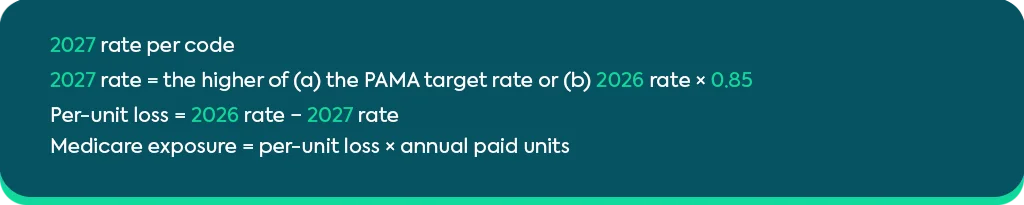
Under current law, reductions to the Clinical Laboratory Fee Schedule (CLFS) of up to 15% per test are scheduled for January 1, 2027. Maybe a delay comes again. Maybe it doesn’t. Either way, a lab that knows its exposure down to the CPT code can make faster, calmer decisions than one working from a headline number.
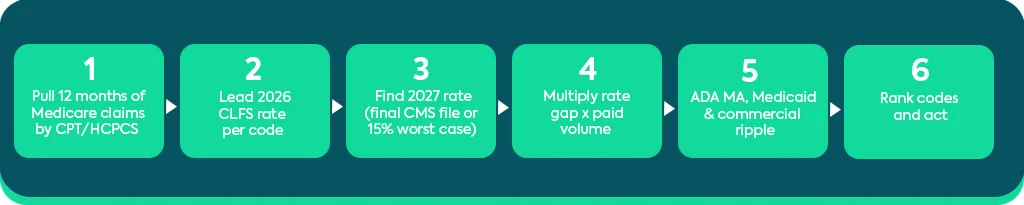
This guide walks through the math. No black box, no vendor software required. Just your claims data, the CMS rate file, and a spreadsheet.
The Protecting Access to Medicare Act (PAMA) changed how Medicare prices most lab tests. Instead of historical fee schedules, CLFS rates are now based on the weighted median of private payer rates that applicable labs report to CMS.
When CMS first applied that method in 2018, many weighted medians came in well below the old rates. To soften the landing, PAMA phased reductions in with an annual cap per test. The first three years (2018 to 2020) were capped at 10% per year. Later years carry a cap of 15% per year. The remaining reductions have been pushed back by Congress repeatedly since then, which is why most rates have sat frozen at roughly their 2020 levels.
| Period | What happened | Why it matters for 2027 |
|---|---|---|
| 2014 | PAMA enacted | Created the private-payer, weighted-median pricing model |
| 2017 | First private payer data reported (2016 collection period) | Set the weighted medians many codes are still sliding toward |
| 2018–2020 | Cuts applied, capped at 10% per test per year | Many routine tests absorbed three straight cuts |
| 2021 onward | Congress repeatedly delayed further cuts and data reporting | Rates largely frozen; the gap to the weighted median stayed open |
| Jan 1, 2027 | Reductions of up to 15% per test scheduled under current law | Each code drops by the lesser of its gap or 15% |
| CPT | Test | 2026 rate | Modeled cut | 2027 rate | Annual units | Exposure |
|---|---|---|---|---|---|---|
| 80053 | Comprehensive metabolic panel | $10.56 | 15.0% | $8.98 | 42,000 | $66,360 |
| 85025 | CBC with automated differential | $7.77 | 6.0% | $7.30 | 38,000 | $17,860 |
| 80061 | Lipid panel | $13.39 | 15.0% | $11.38 | 21,000 | $42,210 |
| 83036 | Hemoglobin A1c | $9.71 | 15.0% | $8.25 | 18,500 | $27,010 |
| 84443 | TSH | $16.80 | 11.5% | $14.87 | 15,000 | $28,950 |
| 82306 | Vitamin D, 25-hydroxy | $29.60 | 15.0% | $25.16 | 9,800 | $43,512 |
| 84153 | PSA, total | $18.39 | 9.0% | $16.73 | 6,200 | $10,292 |
| 87086 | Urine culture, colony count | $8.86 | 0.0% | $8.86 | 7,400 | $0 |
| Total | 157,900 | $236,194 |
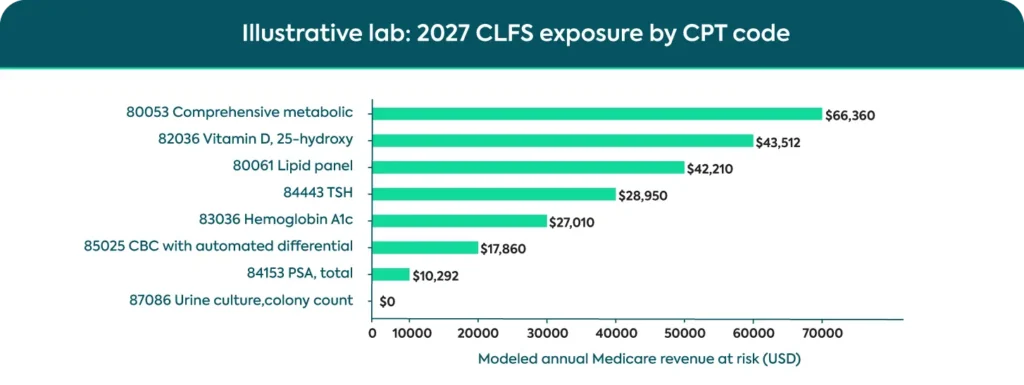
The math tells a clear story. Total modeled exposure is about $236,194 on roughly $1,921,267 of Medicare revenue from these codes, a blended loss of 12.3%. But that blended number hides the shape of the risk. The comprehensive metabolic panel alone accounts for $66,360, or 28% of the total. Vitamin D, at a higher unit price, adds another $43,512 despite far lower volume. The urine culture, modeled here with no cut, contributes nothing.
Now add the ripple. Say this lab also runs 18,000 CMPs a year for a Medicare Advantage plan that pays 100% of the CLFS. That’s another 18,000 × $1.58, or $28,440, on one code and one contract. Repeat that across your top codes and payers, and it’s easy to see how true exposure can run well past the Medicare-only figure.
| Tier | Profile | What to do first |
|---|---|---|
| Tier 1 | High volume + full 15% cut | Model monthly, renegotiate pegged contracts, protect clean-claim rate |
| Tier 2 | High volume + partial cut | Watch for stacked cuts in 2028 and beyond; review test menu pricing |
| Tier 3 | Low volume + full 15% cut | Check whether payer mix or reference-lab sendouts make more sense |
| Tier 4 | Low volume + small or no cut | Monitor only; revisit when the next CLFS file posts |
Unless Congress acts again, the phase-in reductions resume January 1, 2027, capped at 15% per year through 2029.
You don’t need a consultant to run this math. But if you’d rather have a second set of eyes on it, TransLabs, a dedicated lab RCM services provider, works only with laboratories, and our team can help you build a code-level exposure model, find the denials eating into margin, and get your revenue cycle ready for whatever 2027 brings. Reach out whenever the timing feels right.